

Bows, Arrows, and Borders
Every colonial handoff left its mark on Papua New Guinea

“Man dodges arrows in shootout between tribes, Papua New Guinea.”
The headline had all the fingerprints of The Onion. Sadly, it was not.
Actually, let me back up.
There are four Guineas: Guinea, Guinea-Bissau, Equatorial Guinea, and Papua New Guinea. Three are in Africa. One somehow wound up 8,000 miles away in the southwest Pacific because European mapmakers had a habit of naming places after other places they’d already claimed. Colonialism wasn’t just about planting flags. It was also about running out of original ideas.
French Guinea became Guinea. Portuguese Guinea became Guinea-Bissau. Spanish Guinea became Equatorial Guinea. Papua New Guinea eventually stayed Papua New Guinea. Every one of them carries colonial scars in different places: borders, languages, governments, economies. For the sake of time, let’s focus on the one so remote you’d think empire would have overlooked it.
Papua New Guinea is one of the most culturally diverse countries on Earth, with more than 800 languages and thousands of distinct tribal groups. Mountains that look like natural fortresses kept communities separated for centuries, allowing customs, dialects, and identities to evolve independently. Europeans didn’t create that diversity. They simply arrived late enough to complicate it.
The southeastern half of the island became British New Guinea in 1884 before administration passed to Australia. Germany claimed the northeast the very same year, carving an invisible line through cultures that had never asked for one. When World War I arrived, Australia occupied German New Guinea, and after the Treaty of Versailles it became an Australian League of Nations mandate. Following World War II, the territories were combined under Australian administration until Papua New Guinea gained independence in 1975. The flags changed. The governors changed. The people largely stayed where they’d always been.
Colonial governments have always loved straight lines. Tribal societies rarely cooperate.
That’s part of why the recent tribal violence isn’t some relic from the Stone Age, despite what headlines featuring bows and arrows might suggest. The weapons may be ancient, but the conflicts are fueled by thoroughly modern problems: poverty, weak policing, competition over land and resources, and a rapidly changing economy pressing against traditions that evolved over centuries, all layered atop centuries of foreign intrusion, colonial rule, and outside powers reshaping the country’s political and cultural landscape. The violence seen today is not simply tribal; it is the product of traditional societies trying to navigate the lasting consequences of being repeatedly overrun and reinvented by others.
Philately quietly documented every one of these political handoffs.
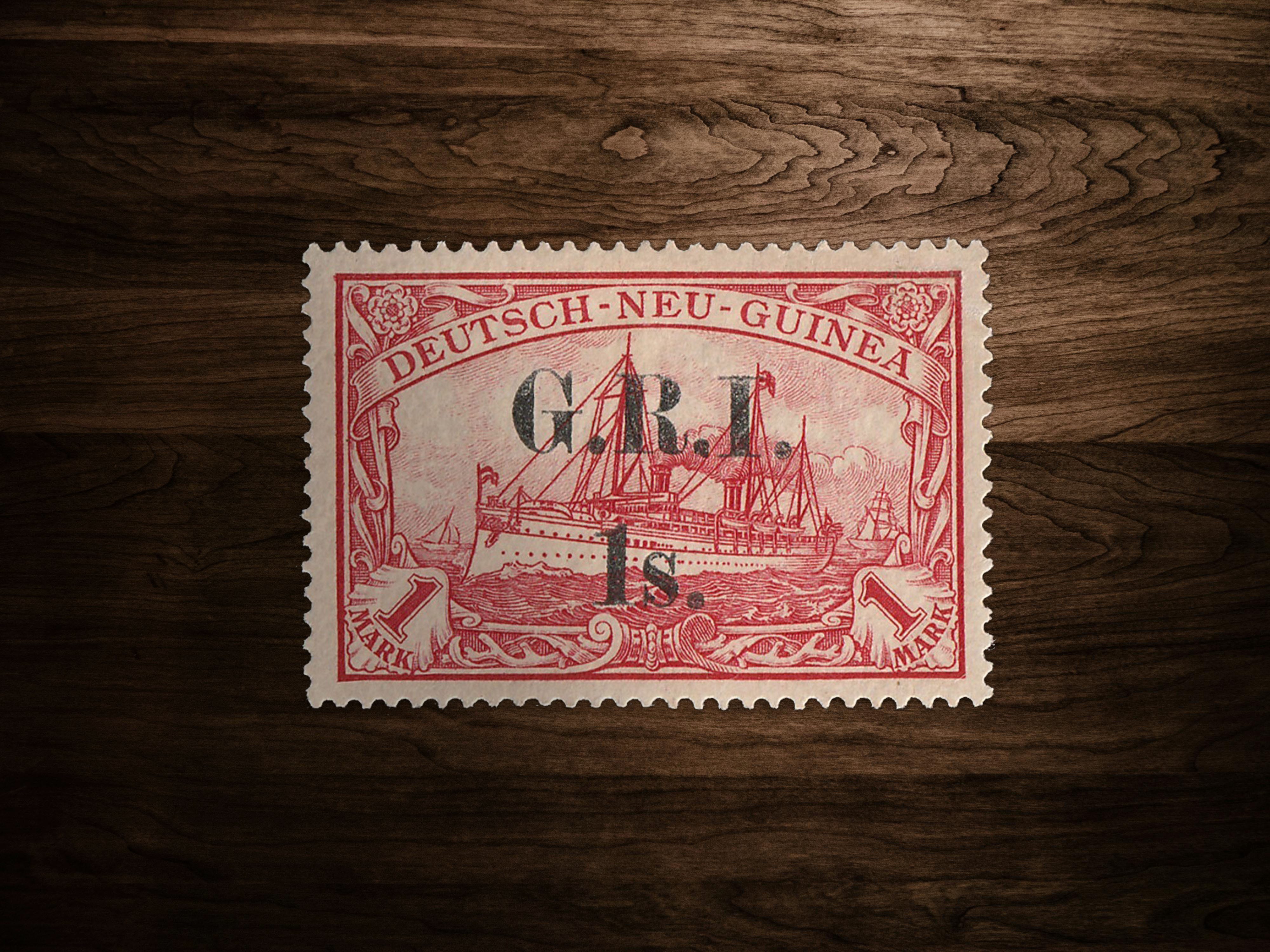
The earliest stamps used in German New Guinea were simply ordinary German Empire issues. In 1897 they were replaced by stamps overprinted “Deutsch-Neu-Guinea,” an empire announcing ownership with little more than a rubber stamp, before giving way to the colony’s distinctive Yacht issues in 1901. On the southeastern side of the island, British New Guinea underwent its own philatelic transformation when Australia’s assumption of administration led to the famous Lakatoi stamps being overprinted “PAPUA” in 1906. A change in government required only a change of ink.
When Australian forces occupied German New Guinea in 1914, those German colonial stamps were hastily overprinted “G.R.I.” (Georgius Rex Imperator) and surcharged in British currency. Soon afterward, Australian Kangaroo and King George V stamps appeared bearing the inscription “N.W. Pacific Islands.” By 1925, the Territory of New Guinea had its own definitive stamps under Australian administration.
After World War II came the combined Territory of Papua and New Guinea. Then, in 1952, the first stamps inscribed “Papua and New Guinea” shifted their imagery away from European monarchs toward indigenous people, village life, and local landscapes. Finally, after independence in 1975, the country’s stamps simply read “Papua New Guinea.” Same mountains. Same villages. Different name across the top.
Without opening a history book, you can literally watch sovereignty changing one overprint at a time. Governments tend to rewrite maps; stamps preserve every draft.
An envelope doesn’t argue. It doesn’t editorialize. It just quietly records who claimed authority that year. Sometimes that’s a more honest history than the one written by the victors.
.